

Geno Giovanni Presents
Politics • Culture • Business
A media and publishing company covering business, politics, and culture.
Interested? Want to learn more about the community?
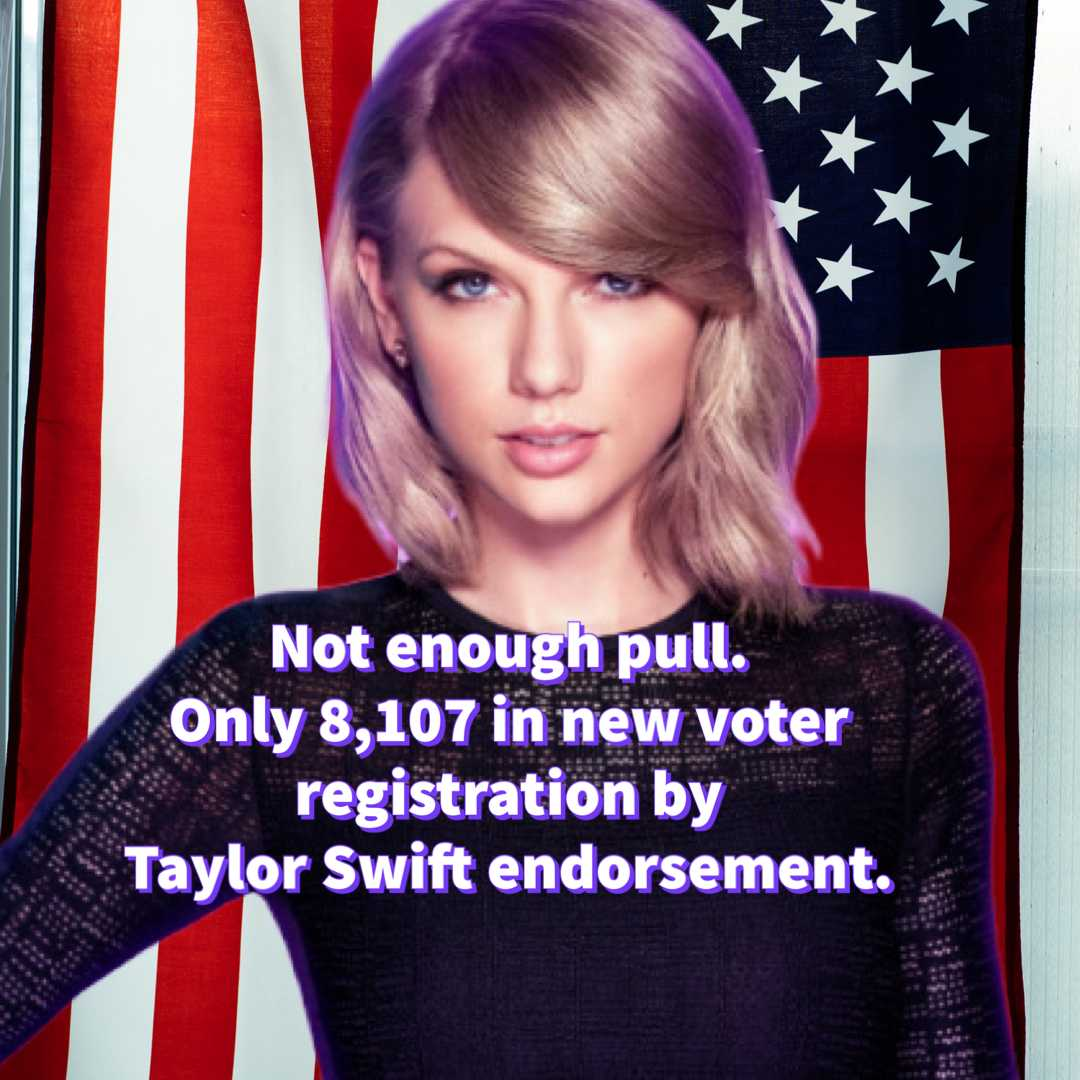
Taylor Swift Mini Pull

Taylor Swift was praised for 35,252 (23% increase) in new voter registration on National Voter Registration Day.
Source: Vote.org

post photo preview
Interested? Want to learn more about the community?
What else you may like…
Videos
Posts
Articles
Big Beautiful Bill Quick Take

H.R. 1 Also known as, the big beautiful bill has past Congress and is currently in the Senate. It’s a reconciliation bill, which means if they’re going to alter existing laws and rules and it doesn’t require a 60 vote in the Senate as votes like this can only happen three times in a fiscal year.

This bill will benefit small businesses, farmers and agricultures, People who work in FAA military military/defense/defense contractors and many more including taxpayers, earning less than $500,000 a year.

In hindsight, it looks like it’s Washington as usual. I’m talking about more spending less cutting and not keeping to their promises of cutting waste.

However, when you read over the bill, you’re gonna find that there’s $1.7 trillion in cuts more than anytime after 2005. And there’s a lot of rule changes with existing laws that go against businesses because of environmental impacts brought on by the Democrats and environmental groups.

There’s also claims that will be tax breaks ...

00:02:25
Cereal For Dinner

Big food wants you to have cereal for dinner as a alternative to what you would normally have. So I tired it and was not a fan.

00:00:09
Syrup Taste Test Showdown: Pearl Milling Co. vs Aunt Jemima

In this must-watch video, we put two iconic syrup brands head-to-head in an epic taste test battle - Pearl Milling Co. and Aunt Jemima. Which syrup reigns supreme?
We'll compare and contrast the flavors, textures, and overall taste experience of these two popular syrups. Get an insider look at the judging process as our panel of food experts meticulously analyzes and scores each syrup.
You'll get the full rundown on:
Flavor profiles (sweetness levels, notes of vanilla, maple, etc.)
Consistency and mouthfeel
Appearance and bottle design
Cost and value for money
But the real question is - who will be crowned the ultimate syrup champion? Pearl Milling Co. or Aunt Jemima? Watch to the end to find out the surprising verdict!
#syrups #pancakesyrup #foodreview #tastetestchallenge #pearlmillingco #auntjemima #breakfastfoods #maplesyrup #foodbattle

00:00:43
post photo preview
The Real World Attention Issue:
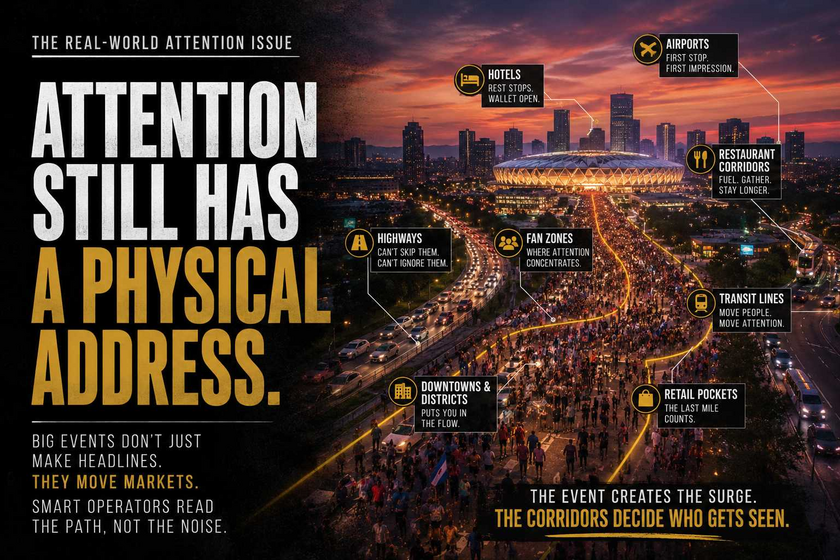
Attention Still Has A Physical Address
Big events reveal what dashboards flatten: attention still has a physical address.
 
When people travel, gather, watch together, and change routines, the market leaves a trail. The World Cup is the current proof point, but the pattern is bigger than the event. Airports, hotels, highways, restaurants, downtowns, transit lines, fan zones, and surrounding roads start carrying different weights.
 
The cameras stay on the headline. The visibility map forms around the movement. When bodies concentrate along specific routes, those routes become more valuable. A road cannot be skipped. A crowd cannot be muted. A clean placement in the right corridor does not need the algorithm’s permission to exist. Digital can still chase attention, but the feed is easier to flood than ever.
 
More creative. More automation. More targeting. More noise. The harder advantage is not adding another message to the stack. It is standing where the customer already is. The center gets expensive fast.
 
Sponsorships, themed campaigns, event language, and social hooks crowd into the same obvious space. The sharper read is the spillover: routes into the district, hotel clusters, restaurant corridors, commuter paths, retail pockets, transit lines, and the roads people use before and after they arrive. The event creates the surge. The corridors decide who gets seen. A brand does not need to own the event. It needs to know where the event sends attention.
 
California, Massachusetts, Texas, and Florida all move differently. National pressure does not create a national template. Each market rewards the operator who reads the local path before the crowd turns it into inventory. The same signal can show up coast to coast, but the winning placement call is always local. Geography is not background. It is the distribution system for real-world attention.
 
For one business, the first move may be a freeway corridor. For another, a suburban retail pocket. For another, the approach to an airport, medical cluster, college district, venue, or downtown route. The right placement is not where the brand wants attention. It is where the audience already repeats behavior.
 
Visibility works when it meets movement already in progress. Timing separates operators from late buyers. Late buyers shop surfaces. Operators read paths.
 
They watch where movement is forming, where repetition is building, and where attention will pass before the rest of the market treats that location like a prize. A late buyer asks what is available. An operator asks what path is about to matter. The brands that win this cycle will not be the ones posting the most, spending the loudest, or chasing every cultural moment after it breaks. They will place visibility before the obvious paths get crowded. Once the crowd is visible to everyone, the advantage is already shrinking. The best corridors get claimed.
 
The cleanest placements get harder to access. Hesitation shows up in the price. By then, the market is selling consensus rather than rewarding foresight. The operator advantage is seeing the corridor before it becomes the headline.
Read full Article
post photo preview
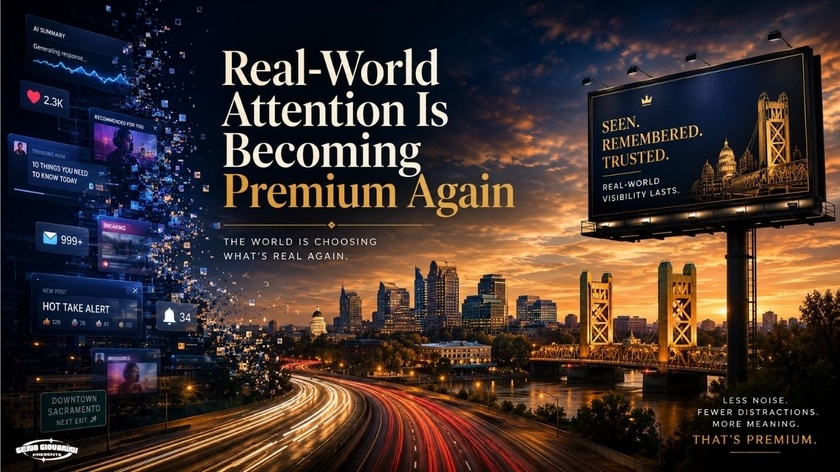
Real-World Attention Is Becoming Premium Again
Why Physical Visibility Is Becoming More Valuable Again
Something is shifting in the attention market.
 
For years, brands were trained to think visibility meant digital reach: impressions, clicks, followers, retargeting, short-form video, search rankings, paid social, email lists, and whatever the algorithm allowed them to touch that week.
That world is not disappearing. Digital media still matters. But it is becoming more crowded, less durable, and harder to trust, just as real-world visibility is starting to feel valuable again.
 
Roads still move people. Events still concentrate crowds. Commuter patterns still create repetition. A strong physical presence still tells the market that this brand is here. That matters more than many operators have admitted.
This is not nostalgia for old advertising. It is a market correction.
 
Out-of-home advertising reached a record $9.46 billion in U.S. revenue in 2025, according to the Out of Home Advertising Association of America, growing 3.6% year over year and extending the category’s growth streak to 19 consecutive quarters. Digital out-of-home also continued to grow, accounting for 36.3% of total OOH revenue and rising 10.5% year over year.
 
That does not mean every billboard works. It does not mean every business should buy outdoor. It means the market is telling us something: while digital attention becomes more fragmented, physical presence is being repriced.
 

The Digital Attention Problem

The internet is no longer just crowded. It is layered.
 
A business owner trying to reach customers online is now competing with creators, AI-generated posts, short-form video, political content, news cycles, memes, podcasts, automated newsletters, influencers, search summaries, paid ads, and platforms that can change distribution rules overnight.
 
Deloitte’s 2025 Digital Media Trends report describes social video platforms as a dominant force in media and entertainment, built around endless algorithmically optimized content and advertising. Deloitte also notes that media companies and advertisers are competing for roughly six hours of daily media and entertainment time per person, and that time is not expanding.
 
That is the pressure point.
 
There may be more content than ever, but there is not more human attention than ever. The supply of media has exploded. The supply of attention has not.
 
Trust is also strained. Reuters Institute’s 2025 Digital News Report found traditional news media struggling with declining engagement, low trust, and stagnating digital subscriptions. That trust problem does not stay locked inside journalism. It spills into the broader digital environment where users are constantly deciding what to ignore, what to skim, what to doubt, and what to believe.
 
Then there is AI.
 
AI has made production faster. It has also made sameness cheaper. Pew Research Center reported in 2026that half of U.S. adults say the increased use of AI in daily life makes them more concerned than excited, while only 10% say they are more excited than concerned. Pew also found that 58% of respondents in one browsing-data analysis encountered at least one search result page with an AI-generated summary during the study period.
 
That does not mean AI is bad. It means the digital information environment is changing quickly, and users know it.
For brands, the implication is simple: digital visibility is still useful, but it is becoming less durable. A post can disappear in hours. A paid campaign can fatigue. A search result can be compressed by an AI answer. A video can hit one week and vanish the next.
 
The market is not only fighting for attention. It is fighting for memory.
 

Why Real-World Visibility Still Works

Real-world visibility works because it behaves differently.
A billboard does not ask for a login. A commuter does not need to follow your account. A driver does not need to beat the algorithm to see the message. A regional audience does not need to search for the brand first.
That is the strategic difference.
 
Outdoor advertising is not only about one impression. It is about repeated presence inside a physical market. A board on a commuter corridor, a digital screen near a commercial district, or a placement tied to a high-traffic route can do something digital often struggles to do: make a brand feel physically present.
That presence matters because people still live in geography.
 
They drive to work. They pass through corridors. They visit shopping centers. They attend events. They move between suburbs, downtowns, entertainment districts, job sites, campuses, airports, arenas, and restaurants. Those movements create attention patterns that are not fully captured by online targeting tools.
The mistake is treating outdoor as “old media.”
 
The better way to understand it is as market terrain.
 
In Sacramento, that terrain looks different than the Bay Area. Highway 50 does not behave like I-80. Business 80 does not behave like a suburban arterial. Roseville visibility is not the same as downtown Sacramento visibility. A board near a commuter route is not the same as a board near destination traffic.
 
This is where the operator's view matters.
The question is not, “Should I buy a billboard?”
 
The question is, “Where is attention physically moving, who is passing through it, and what kind of message earns memory in that environment?”
That is a different discipline.
 

Summer 2026 and the Return of Movement

Summer 2026 is not just another summer.
 
Travel, events, sports, and regional movement are all part of the visibility equation. The FIFA World Cup runs from June 11 through July 19, 2026, across North America, and the San Francisco Bay Area is hosting six matches at Levi’s Stadium in Santa Clara.
 
That does not mean every local business should assume a guaranteed traffic windfall. The smarter interpretation is more measured: major events concentrate attention, increase movement, create cultural moments, and push brands to think earlier about physical visibility.
 
U.S. Travel’s Spring 2026 forecast projects total U.S. travel spending at $1.37 trillion in 2026, with international inbound travel supported in part by World Cup-related movement. The same forecast notes that travelers are expected to shift toward shorter-duration and lower-cost trips, including regional and drive markets, because of cost pressures.
That point matters for operators.
 
Not all movement is airport movement. Not all event visibility happens at the stadium. Some of the most important attention happens around the event: watch parties, restaurants, hotels, regional drives, fan zones, local gatherings, shopping routes, freeway corridors, and business districts that become part of the broader movement pattern.
The World Cup is the headline. But the broader trend is bigger than soccer.
 
People are still gathering. They are still traveling. They are still commuting. They are still responding to physical cues in the marketplace. Brands that understand that early can start thinking beyond the feed.
 

What GGP Is Watching

At GGP, the shift is not being read as a billboard trend alone.
It is being read as a visibility trend.
 
The market is moving toward a more blended reality: digital still drives discovery, but physical visibility creates weight. Online content may introduce the brand, but real-world repetition can make it feel established. A newsletter may educate the buyer, but a corridor presence can signal that the brand is serious about a region.
 
That is the layer many agencies miss.
 
They sell the channel. Operators study the market.
 
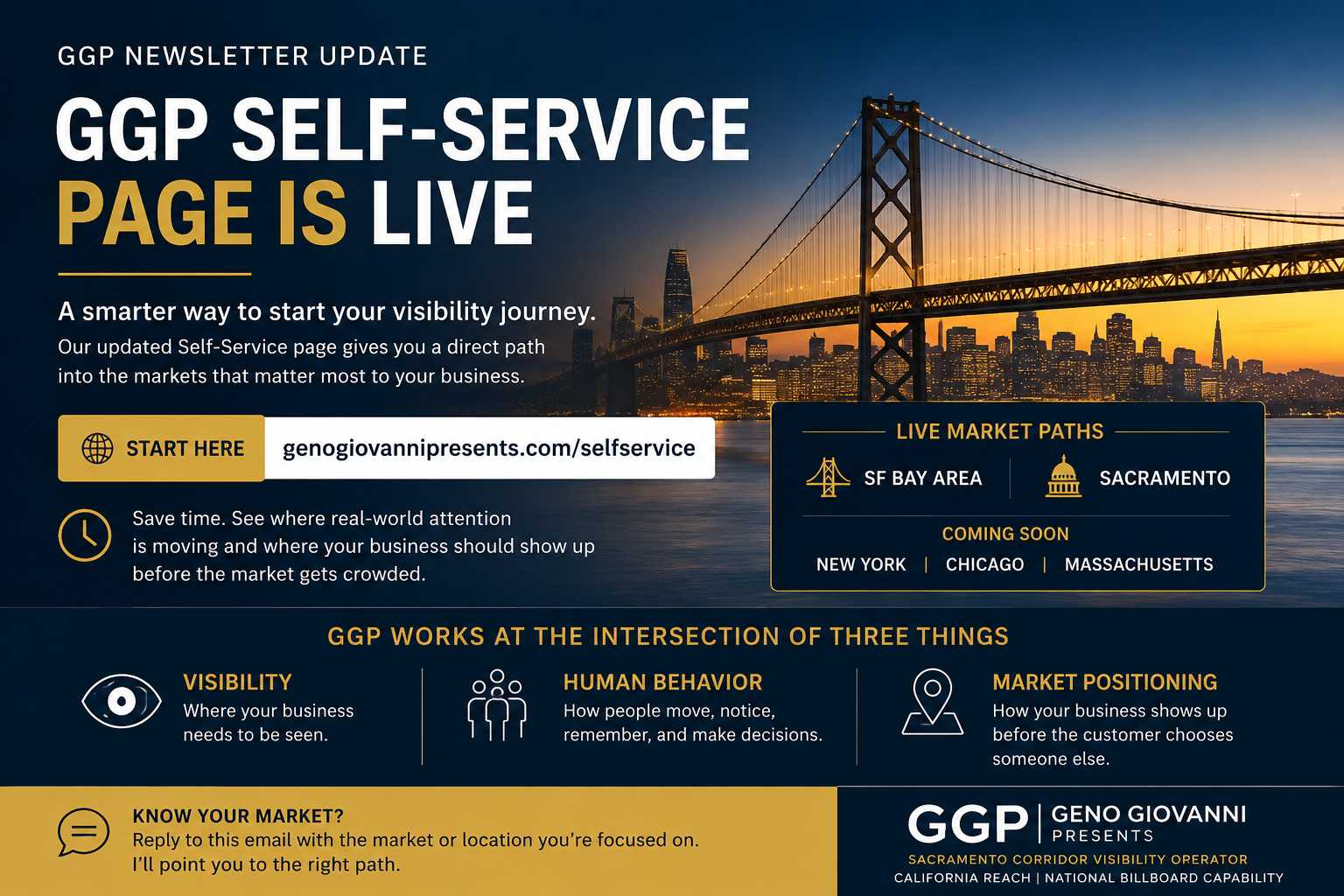
GGP is watching Sacramento because Sacramento is not a generic media market. It is a regional movement system. It has commuter routes, suburban growth, political visibility, development pressure, sports traffic, event traffic, and business corridors that behave differently depending on the audience.
 
GGP is watching the Bay Area because Northern California visibility does not stop at one city line. Sacramento brands look west. Bay Area brands look inland. Regional operators increasingly need to understand how attention moves between cities, not just inside them.
 
GGP is also watching the national market because the same pattern is showing up elsewhere: digital channels are crowded, AI is increasing content supply, trust is under pressure, and physical attention is becoming more valuable where people actually move.
 
That is the foundation of GGP 3.0.
 
Not simply selling advertising space.
 
Not posting content for content’s sake.
 
Not chasing every digital tactic because the market says to chase it.
 
The direction is more specific: market intelligence, visibility strategy, outdoor advertising interpretation, and operator-level guidance for brands that need to be seen in the real world.
 
The Newsdesk returning under that frame matters. It gives GGP a way to document what is happening before the market fully prices it in.
 

The Brands That See It Early

The next phase of attention will not be purely digital or purely physical.
It will belong to brands that understand how the two reinforce each other.
 
Digital creates speed. Physical creates weight.
 
Digital can target. Outdoor can be established.
 
Digital can start a conversation. Real-world visibility can make the brand harder to ignore.
 
The businesses that win will not be the ones that simply buy more impressions. They will be the ones who understand where attention is becoming scarce, where trust is weakening, where movement is increasing, and where physical presence can create memory.
 
Real-world attention is becoming premium again.
 
Not because the internet is over.
 
Because the market is crowded, people are moving, and visibility that can be seen, repeated, and remembered is becoming harder to fake.
 
GGP will be watching that shift closely.
 
And for the brands paying attention now, the opportunity is not just to advertise.
 
It is to show up before the rest of the market realizes the terrain has changed.
Read full Article
post photo preview
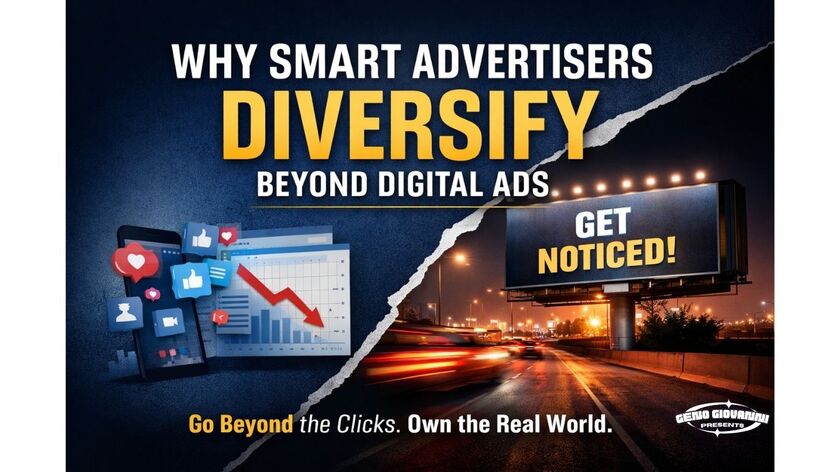
Why Smart Advertisers Diversify Beyond Digital Ads

Many businesses reach the same inflection point: digital metrics look active, but business outcomes flatten. Clicks may rise. Impressions may increase. Yet revenue growth, market visibility, and customer acquisition often fail to scale in proportion to spend.

That gap is one reason diversification has become a practical media strategy rather than a branding luxury.

Digital advertising remains useful, especially for search intent, retargeting, and direct response. But it also faces structural limitations. Average display click-through rates remain low, ad fraud continues to drain significant spend from the online ecosystem, and privacy controls have reduced the precision advertisers once relied on for tracking and targeting.

In parallel, out-of-home advertising continues to hold strategic value because it solves a different problem.

OOH is not primarily a click medium. It is a visibility medium.

It places the brand in public space, in commuting patterns, in retail corridors, and in repeated real-world exposure. Recent OOH industry materials show high audience notice levels, and current market guides continue to position digital out-of-home as a growing segment of the broader OOH market.

That does not mean every billboard impression equals perfect attention. It does mean OOH is not exposed to bot-click fraud in the same way digital media is. It also means the medium cannot be skipped with a browser extension or filtered out of a social feed. That distinction matters when brands want durable local visibility.

For advertisers, the key shift is this:

The question is no longer digital or outdoor.
The better question is which part of the funnel each channel should own.

A stronger media mix often looks like this:

  • Google Ads for demand capture

  • Paid social for engagement and remarketing

  • OOH / DOOH for reach, frequency, and geographic dominance

Modern digital out-of-home also gives advertisers more flexibility than legacy outdoor buying. Current OOH materials highlight capabilities such as dynamic creative, scheduling by time or context, and centralized campaign management across multiple screens.

For a regional advertiser, that creates a more balanced system:

  • digital channels capture active interest,

  • outdoor builds memory and repeated exposure,

  • and the combination reduces dependence on any one platform’s pricing, targeting rules, or algorithm changes.

Bottom line:
Diversification is not an anti-digital argument. It is a risk-management and market-presence argument.

Businesses that rely exclusively on platform-based attention are vulnerable to rising costs, measurement volatility, fraud, and policy changes. Businesses that combine digital with out-of-home are better positioned to sustain visibility, reinforce recall, and defend share of attention in the physical market.


Sources

Click-through rates (low engagement in display advertising)
WordStream reports average Google Display Network click-through rates around ~0.46%, indicating the majority of impressions do not generate user action.
https://www.wordstream.com/blog/ws/2016/02/29/google-adwords-industry-benchmarks

Ad fraud and invalid traffic in digital advertising
Juniper Research estimates advertisers lose approximately $84 billion annually to ad fraud, highlighting systemic inefficiencies in digital media buying.
https://www.juniperresearch.com/press/press-releases/ad-fraud-costs-to-advertisers-to-reach-84bn

Privacy changes impacting tracking and attribution
Apple introduced App Tracking Transparency (ATT), limiting cross-app tracking and reducing advertisers’ ability to measure and target users with the same precision as before.
https://developer.apple.com/app-store/user-privacy-and-data-use/

Out-of-home (OOH) reach and visibility
Out of Home Advertising Association of America reports that a large majority of U.S. adults are reached by OOH advertising weekly, reinforcing its role as a high-reach, real-world media channel.
https://oaaa.org/Insights/OOH-Fact-Sheet.aspx

Growth of digital out-of-home (DOOH)
Out of Home Advertising Association of America notes that roughly one-third of OOH revenue is now digital, with continued growth driven by programmatic and dynamic capabilities.
https://oaaa.org/news/new-study-finds-digital-out-of-home-advertising-surpasses-other-media-in-driving-favorability-and-action-among-consumers/

Cross-channel effectiveness / media mix importance
Nielsen research consistently shows that combining channels (including OOH with digital) improves overall campaign effectiveness and brand recall.
https://www.nielsen.com/insights/


Read full Article
See More
Available on mobile and TV devices
google store google store app store app store
google store google store app tv store app tv store amazon store amazon store roku store roku store
Powered by Locals