




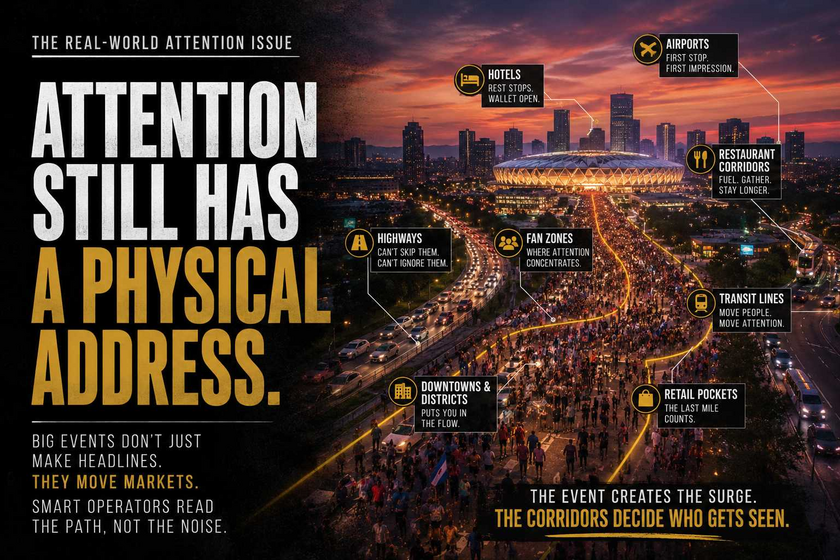
Big events reveal what dashboards flatten: attention still has a physical address.
When people travel, gather, watch together, and change routines, the market leaves a trail. The World Cup is the current proof point, but the pattern is bigger than the event. Airports, hotels, highways, restaurants, downtowns, transit lines, fan zones, and surrounding roads start carrying different weights.
The cameras stay on the headline. The visibility map forms around the movement. When bodies concentrate along specific routes, those routes become more valuable. A road cannot be skipped. A crowd cannot be muted. A clean placement in the right corridor does not need the algorithm’s permission to exist. Digital can still chase attention, but the feed is easier to flood than ever.
More creative. More automation. More targeting. More noise. The harder advantage is not adding another message to the stack. It is standing where the customer already is. The center gets expensive fast.
Sponsorships, themed campaigns, event language, and social hooks crowd into the same obvious space. The sharper read is the spillover: routes into the district, hotel clusters, restaurant corridors, commuter paths, retail pockets, transit lines, and the roads people use before and after they arrive. The event creates the surge. The corridors decide who gets seen. A brand does not need to own the event. It needs to know where the event sends attention.
California, Massachusetts, Texas, and Florida all move differently. National pressure does not create a national template. Each market rewards the operator who reads the local path before the crowd turns it into inventory. The same signal can show up coast to coast, but the winning placement call is always local. Geography is not background. It is the distribution system for real-world attention.
For one business, the first move may be a freeway corridor. For another, a suburban retail pocket. For another, the approach to an airport, medical cluster, college district, venue, or downtown route. The right placement is not where the brand wants attention. It is where the audience already repeats behavior.
Visibility works when it meets movement already in progress. Timing separates operators from late buyers. Late buyers shop surfaces. Operators read paths.
They watch where movement is forming, where repetition is building, and where attention will pass before the rest of the market treats that location like a prize. A late buyer asks what is available. An operator asks what path is about to matter. The brands that win this cycle will not be the ones posting the most, spending the loudest, or chasing every cultural moment after it breaks. They will place visibility before the obvious paths get crowded. Once the crowd is visible to everyone, the advantage is already shrinking. The best corridors get claimed.
The cleanest placements get harder to access. Hesitation shows up in the price. By then, the market is selling consensus rather than rewarding foresight. The operator advantage is seeing the corridor before it becomes the headline.