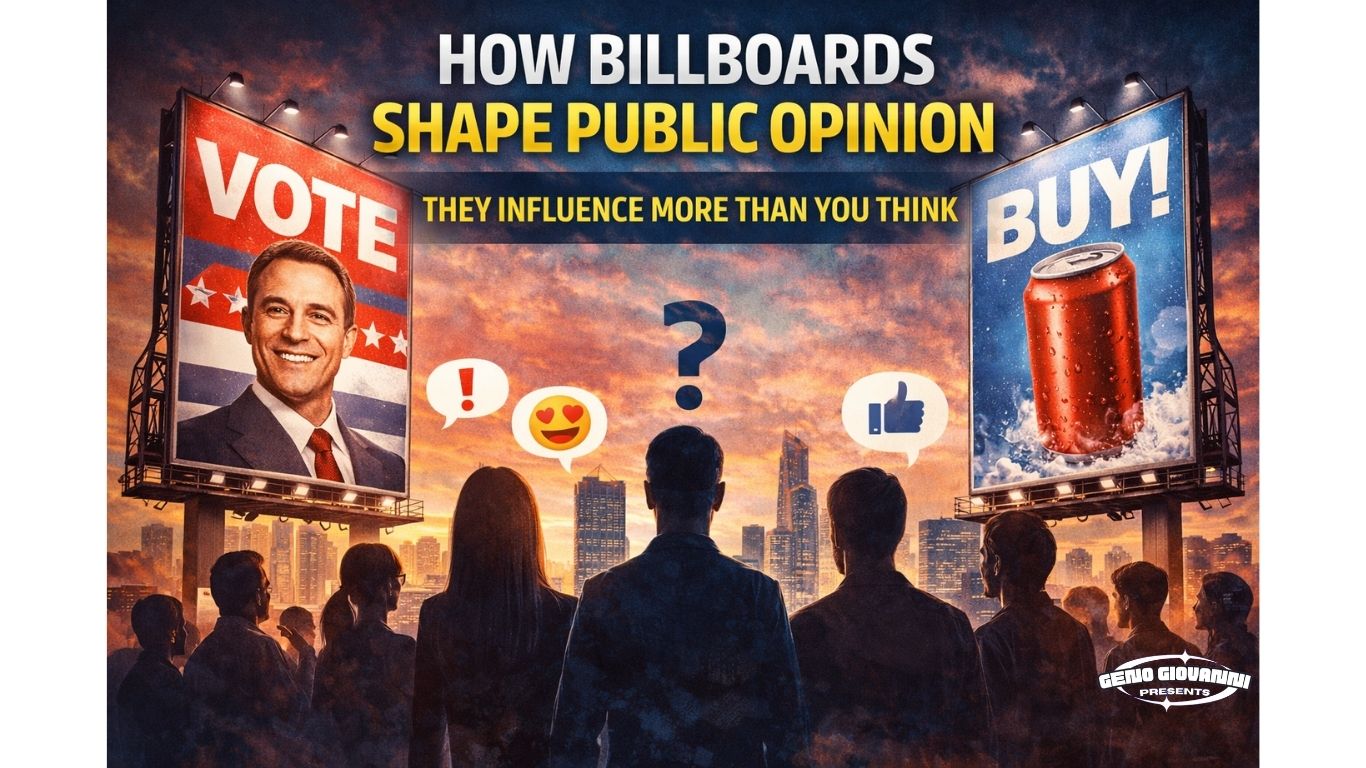
In early 2026, an artificial intelligence bill moved through the Utah legislature—largely unnoticed by the general public.
That changed when a series of digital billboards appeared in Salt Lake City, addressing the debate directly and calling attention to the issue.
The bill ultimately did not pass before the legislative session ended, but the campaign revealed something more important than the outcome:
Billboards can rapidly inject an issue into public awareness—especially at the local level where policy decisions are made.
Main Point
Billboards are not just commercial tools. In policy, advocacy, and public affairs, they function as geographic amplification systems—placing messages directly into the physical environments where voters, media, and decision-makers operate.
The Utah AI bill situation did not prove that billboards “decide” outcomes.
What it demonstrated is this:
When deployed strategically, billboards can accelerate awareness, frame narratives, and increase pressure in ways digital channels often cannot.
Point 1: Geographic Precision — Influence Happens Locally
Policy is decided locally. Attention must be created locally.
During the Utah AI bill debate, messaging was placed within Salt Lake City, where:
State legislators work and commute
Media coverage is concentrated
Advocacy activity is at its highest
This reflects a core principle:
Influence is not about national reach. It is about relevant reach.
Why this matters:
Legislative proximity: Messaging placed near a state capitol or major commuter corridors increases the likelihood that policymakers and politically engaged audiences encounter it.
Constituent alignment: Local residents—not national audiences—contact representatives, attend hearings, and shape political pressure.
Efficient spend: Targeted outdoor placements concentrate impressions where they can affect outcomes, rather than dispersing them across irrelevant geographies.
Strategic takeaway:
If the objective is to influence a state or municipal issue, media placement must align with the geographic footprint of decision-making, not the size of the total audience.
Point 2: Persistent Visibility — Physical Media Creates Repetition
Digital messaging competes for attention. Physical media occupies space.
Billboards operate on a different exposure model:
They are continuously visible
They do not require user interaction
They deliver repeated impressions over time
In a commuting environment, this creates:
Frequency accumulation (the same audience sees the message multiple times)
Message familiarity (recognition increases with repetition)
Baseline awareness (even passive exposure introduces the topic)
It is inaccurate to say billboards are “unavoidable,” but it is accurate to say:
They are consistently present in a way digital ads are not.
In the Utah case:
The billboards did not explain the full legislation
They did not require clicks or engagement
They simply ensured the issue became visible in the public environment
Strategic takeaway:
When awareness is low, the first objective is not persuasion—it is exposure.
Billboards are highly effective at establishing that baseline.
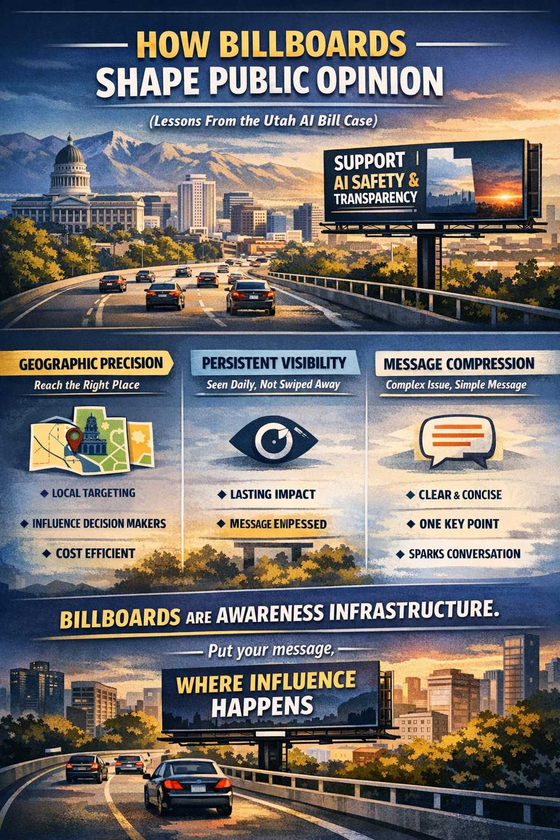
Point 3: Message Compression — Complexity Becomes a Position
Legislation is complex. Public opinion is not.
Billboards impose strict constraints:
Limited words
Short viewing time
High emphasis on clarity
This forces campaigns to:
Define a single position
Use simple, memorable language
Focus on framing, not explanation
In practice, this means:
The audience may not understand the full policy
But they understand what the issue is about
And often, which side they align with
This is not unique to billboards, but billboards enforce it more aggressively than most media.
Strategic takeaway:
If a message cannot be reduced to a clear, repeatable idea, it will not scale in public discourse—regardless of channel.
What the Utah Case Actually Demonstrates
The Utah AI bill campaign does not prove causation between billboards and legislative outcomes.
It does demonstrate three measurable effects:
Issue visibility can be created quickly in a defined geography
Physical media can reinforce a narrative through repetition
Simple framing can enter public conversation without requiring deep engagement
These are not theoretical advantages. They are operational realities of outdoor media.
Conclusion: Billboards as Awareness Infrastructure
Billboards are best understood not as persuasion tools in isolation, but as infrastructure for attention.
They do not:
Replace digital targeting
Deliver granular attribution
Provide detailed messaging
They do:
Establish presence
Reinforce messaging through repetition
Anchor issues in physical space
In policy, advocacy, and regional campaigns, this makes them uniquely useful.
Digital channels distribute messages.
Billboards convey messages.
And in many cases, where a message appears matters as much as what it says.
Final Position
The Utah AI bill case is not evidence that billboards “win” political fights.
It is evidence of something more foundational:
If people are not aware of an issue, nothing else matters.
Billboards remain one of the most direct ways to ensure that awareness exists—
in the exact places where decisions, conversations, and influence actually occur.
Sources
Axios — White House pressures Utah on AI transparency bill (Feb 2026)
https://www.axios.com/2026/02/15/white-house-utah-ai-transparency-billAxios — Utah billboards target AI policy debate (Feb 26, 2026)
https://www.axios.com/2026/02/26/utah-billboards-david-sacks-ai-billAxios — White House scrutiny of state AI laws (Mar 6, 2026)
https://www.axios.com/2026/03/06/white-house-red-state-ai-laws-scrutinyMintz — Utah AI bill policy analysis (Feb 27, 2026)
https://www.mintz.com/insights-center/viewpoints/54731/2026-02-27-white-house-ai-policy-update-utah-ai-bill-opposition