

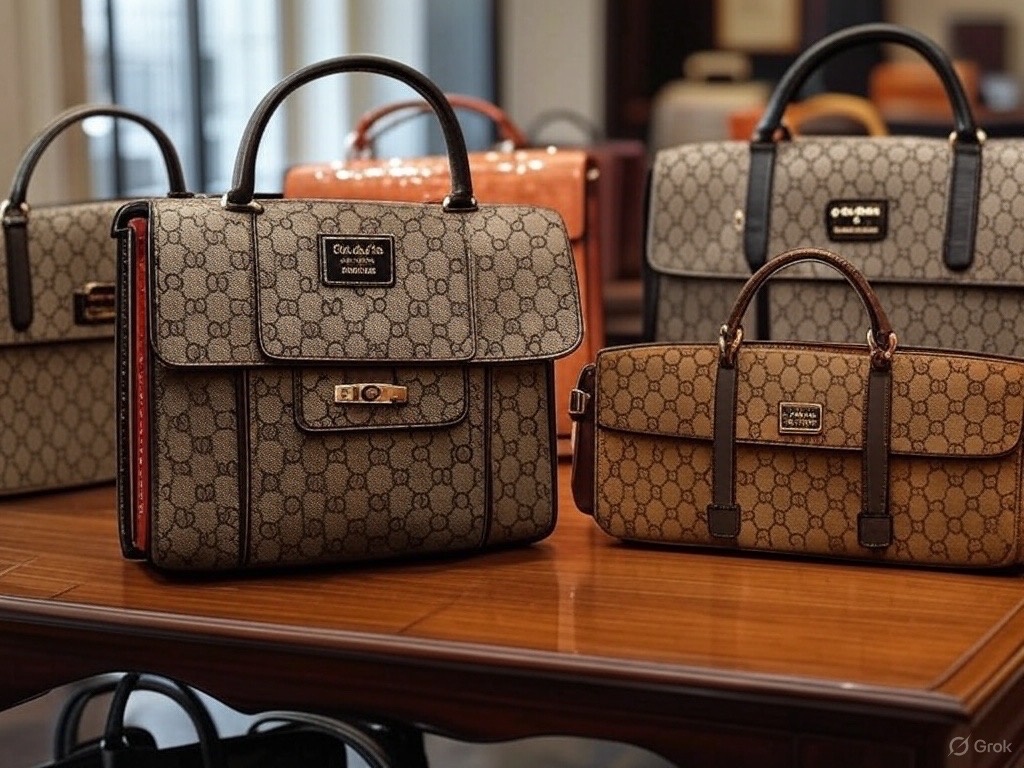


In the world of luxury fashion, brands like Prada, Gucci, and Hermès command eye-watering prices, with handbags retailing for thousands and Birkin bags fetching upwards of $34,000. Yet, a growing body of evidence reveals a stark reality: many of these high-end products are manufactured in China at a fraction of their retail cost, with markups as high as 40 times the production price. This practice, exposed by Chinese manufacturers and amplified on platforms like TikTok, highlights how luxury brands cater to affluent clientele by leveraging brand prestige over actual production value.
The China Connection
Luxury brands have increasingly shifted production to China, capitalizing on the country’s skilled labor, advanced manufacturing, and lower costs. Here’s a look at some prominent names:
Prada: Handbags and shoes costing $30 to produce in Chinese factories retail for $500 or more. Miuccia Prada has praised China’s manufacturing quality, yet the brand’s prices reflect its logo, not its costs.
Gucci: Up to 80% of luxury handbags, including Gucci’s, are made in China for $30-$50, yet sell for $1,000-$3,000.
Louis Vuitton: Bags costing $50 to make are sold for $2,000-$5,000, with Chinese suppliers confirming their role in production.
Hermès: A Birkin bag, retailing for $34,000, costs just $1,400 to manufacture in China—a markup of 24 times.
Chanel and Dior: Handbags costing $50-$100 are sold for $5,000-$10,000, with branding driving the price.
Coach, Armani, Burberry, and Balenciaga**: These brands produce items like bags, scarves, and sneakers in China for $10-$100, retailing for $300-$2,000.
Chinese manufacturers emphasize that their factories use high-quality materials and skilled craftsmanship, debunking the stereotype of “Made in China” as inferior. Yet, these brands often ship goods to Europe for final assembly, allowing them to label products as “Made in France” or “Made in Italy” under EU rules, further inflating perceived value.
The Markup Game
The disparity between production costs and retail prices is staggering. Social media posts and manufacturer videos reveal that luxury goods often cost 1/10th to 1/40th of their retail price to produce. For instance, a $500 Gucci bag may cost $30 to make, while a $34,000 Birkin bag costs $1,400. Over 90% of the retail price is attributed to the brand’s logo, marketing, and exclusivity, not materials or labor.
This “luxury illusion” is designed to appeal to wealthy and aspirational consumers who associate logos with status. In Western markets, these brands target high-net-worth individuals, while in Asia, particularly China, they attract tourists and status-conscious buyers. However, younger Chinese consumers are increasingly favoring local brands, driven by nationalism and frustration with inflated prices.
The Trade War and Transparency
The U.S.-China trade war, with tariffs as high as 145% on Chinese goods, has prompted Chinese manufacturers to speak out. On TikTok and other platforms, they showcase their role as OEM (Original Equipment Manufacturer) factories for luxury brands, urging consumers to buy directly at a fraction of the cost. These revelations challenge the narrative of exclusivity and craftsmanship that luxury brands rely on, exposing them as “high-markup middlemen.”
A Shift in Perspective
The luxury industry’s reliance on Chinese manufacturing is not new, but the transparency brought by social media and global trade tensions has shifted the conversation. Consumers are beginning to question the value of paying thousands for a logo when the same quality can be sourced directly for less. As one TikTok user put it, “Why pay $5,000 for a bag that costs $50 to make? The logo isn’t worth it.”
Conclusion
Brands like Prada, Gucci, and Hermès have built empires on the perception of exclusivity, but their reliance on Chinese manufacturing and astronomical markups reveals a different story. As consumers become savvier, the luxury illusion may start to fade, forcing brands to rethink their pricing strategies or face growing skepticism. For now, the question remains: is a logo worth 40 times the price of quality craftsmanship?
Sources: Industry reports, manufacturer statements, and social media insights. For more on luxury pricing, check <a href="https://x.ai/grok." rel="nofollow noopener noreferrer" target="_blank" class="link">https://x.ai/grok.*
H.R. 1 Also known as, the big beautiful bill has past Congress and is currently in the Senate. It’s a reconciliation bill, which means if they’re going to alter existing laws and rules and it doesn’t require a 60 vote in the Senate as votes like this can only happen three times in a fiscal year.
This bill will benefit small businesses, farmers and agricultures, People who work in FAA military military/defense/defense contractors and many more including taxpayers, earning less than $500,000 a year.
In hindsight, it looks like it’s Washington as usual. I’m talking about more spending less cutting and not keeping to their promises of cutting waste.
However, when you read over the bill, you’re gonna find that there’s $1.7 trillion in cuts more than anytime after 2005. And there’s a lot of rule changes with existing laws that go against businesses because of environmental impacts brought on by the Democrats and environmental groups.
There’s also claims that will be tax breaks ...
Big food wants you to have cereal for dinner as a alternative to what you would normally have. So I tired it and was not a fan.
In this must-watch video, we put two iconic syrup brands head-to-head in an epic taste test battle - Pearl Milling Co. and Aunt Jemima. Which syrup reigns supreme?
We'll compare and contrast the flavors, textures, and overall taste experience of these two popular syrups. Get an insider look at the judging process as our panel of food experts meticulously analyzes and scores each syrup.
You'll get the full rundown on:
Flavor profiles (sweetness levels, notes of vanilla, maple, etc.)
Consistency and mouthfeel
Appearance and bottle design
Cost and value for money
But the real question is - who will be crowned the ultimate syrup champion? Pearl Milling Co. or Aunt Jemima? Watch to the end to find out the surprising verdict!
#syrups #pancakesyrup #foodreview #tastetestchallenge #pearlmillingco #auntjemima #breakfastfoods #maplesyrup #foodbattle
GGP makes it simple to plan and book digital billboard campaigns market by market — so you know exactly where your dollars go before you spend. https://www.genogiovannipresents.com/selfservice
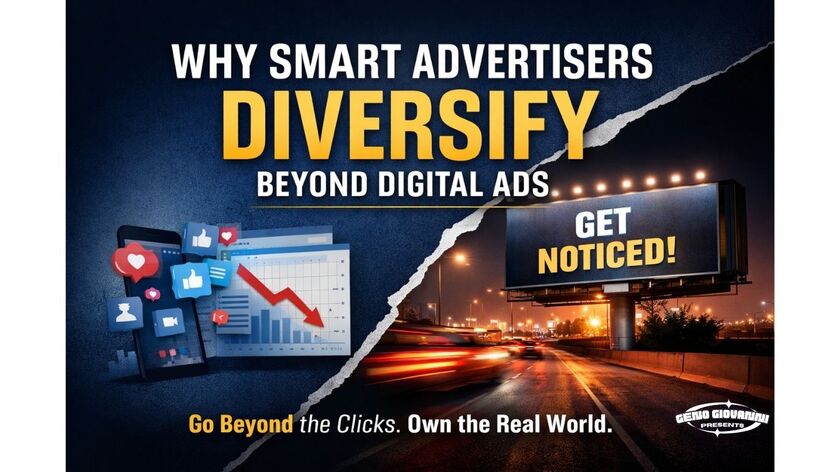
Many businesses reach the same inflection point: digital metrics look active, but business outcomes flatten. Clicks may rise. Impressions may increase. Yet revenue growth, market visibility, and customer acquisition often fail to scale in proportion to spend.
That gap is one reason diversification has become a practical media strategy rather than a branding luxury.
Digital advertising remains useful, especially for search intent, retargeting, and direct response. But it also faces structural limitations. Average display click-through rates remain low, ad fraud continues to drain significant spend from the online ecosystem, and privacy controls have reduced the precision advertisers once relied on for tracking and targeting.
In parallel, out-of-home advertising continues to hold strategic value because it solves a different problem.
OOH is not primarily a click medium. It is a visibility medium.
It places the brand in public space, in commuting patterns, in retail corridors, and in repeated real-world exposure. Recent OOH industry materials show high audience notice levels, and current market guides continue to position digital out-of-home as a growing segment of the broader OOH market.
That does not mean every billboard impression equals perfect attention. It does mean OOH is not exposed to bot-click fraud in the same way digital media is. It also means the medium cannot be skipped with a browser extension or filtered out of a social feed. That distinction matters when brands want durable local visibility.
For advertisers, the key shift is this:
The question is no longer digital or outdoor.
The better question is which part of the funnel each channel should own.
A stronger media mix often looks like this:
Google Ads for demand capture
Paid social for engagement and remarketing
OOH / DOOH for reach, frequency, and geographic dominance
Modern digital out-of-home also gives advertisers more flexibility than legacy outdoor buying. Current OOH materials highlight capabilities such as dynamic creative, scheduling by time or context, and centralized campaign management across multiple screens.
For a regional advertiser, that creates a more balanced system:
digital channels capture active interest,
outdoor builds memory and repeated exposure,
and the combination reduces dependence on any one platform’s pricing, targeting rules, or algorithm changes.
Bottom line:
Diversification is not an anti-digital argument. It is a risk-management and market-presence argument.
Businesses that rely exclusively on platform-based attention are vulnerable to rising costs, measurement volatility, fraud, and policy changes. Businesses that combine digital with out-of-home are better positioned to sustain visibility, reinforce recall, and defend share of attention in the physical market.
Click-through rates (low engagement in display advertising)
WordStream reports average Google Display Network click-through rates around ~0.46%, indicating the majority of impressions do not generate user action.
https://www.wordstream.com/blog/ws/2016/02/29/google-adwords-industry-benchmarks
Ad fraud and invalid traffic in digital advertising
Juniper Research estimates advertisers lose approximately $84 billion annually to ad fraud, highlighting systemic inefficiencies in digital media buying.
https://www.juniperresearch.com/press/press-releases/ad-fraud-costs-to-advertisers-to-reach-84bn
Privacy changes impacting tracking and attribution
Apple introduced App Tracking Transparency (ATT), limiting cross-app tracking and reducing advertisers’ ability to measure and target users with the same precision as before.
https://developer.apple.com/app-store/user-privacy-and-data-use/
Out-of-home (OOH) reach and visibility
Out of Home Advertising Association of America reports that a large majority of U.S. adults are reached by OOH advertising weekly, reinforcing its role as a high-reach, real-world media channel.
https://oaaa.org/Insights/OOH-Fact-Sheet.aspx
Growth of digital out-of-home (DOOH)
Out of Home Advertising Association of America notes that roughly one-third of OOH revenue is now digital, with continued growth driven by programmatic and dynamic capabilities.
https://oaaa.org/news/new-study-finds-digital-out-of-home-advertising-surpasses-other-media-in-driving-favorability-and-action-among-consumers/
Cross-channel effectiveness / media mix importance
Nielsen research consistently shows that combining channels (including OOH with digital) improves overall campaign effectiveness and brand recall.
https://www.nielsen.com/insights/