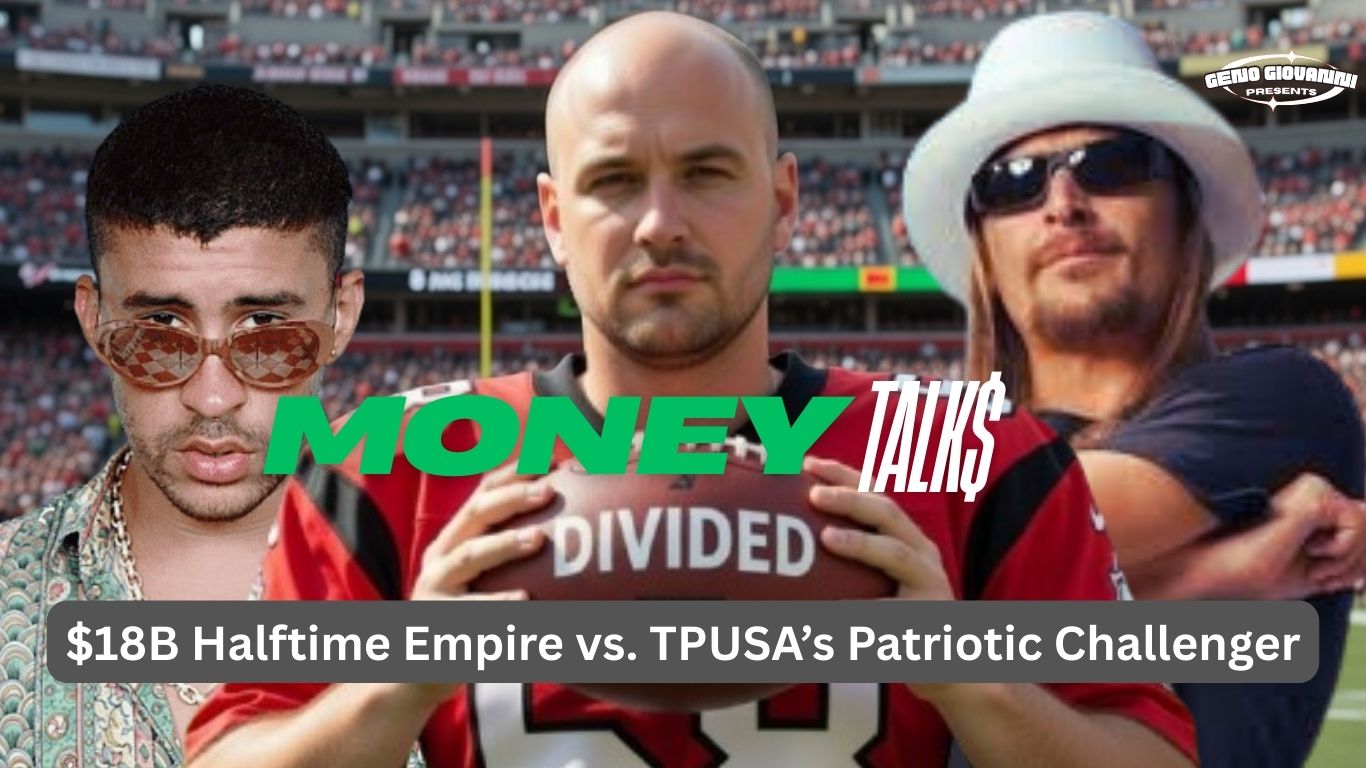
In the high-stakes world of American entertainment, where billions of dollars collide with cultural and political undercurrents, the 2026 Super Bowl LX halftime spectacle offered a stark illustration of an age-old adage: those with deeper pockets often shape the story. On February 8, 2026, at Levi’s Stadium in Santa Clara, California, Puerto Rican superstar Bad Bunny headlined the official Apple Music Super Bowl Halftime Show, drawing an estimated 135 million viewers and shattering previous records.
This dueling duo of performances wasn’t just about music; it highlighted profound divides in American society, raising questions about who controls the cultural narrative in an era of polarization. From multiple perspectives, the contrast reveals how finance might intersect with ideology.
The NFL, a behemoth with annual revenues exceeding $18 billion, leverages its resources to push inclusive, globalist-leaning themes, while TPUSA, with a more modest budget (estimated in the low millions for its event), positions itself as a grassroots challenger defending traditional values. Critics argue this imbalance allows elites to dominate discourse, potentially marginalizing conservative voices, while supporters see it as progress reflecting America’s evolving demographics.
Nuances abound: the NFL’s approach risks alienating core fans, as seen in social media backlash, while TPUSA’s effort, though smaller, demonstrated viable alternative media ecosystems. Implications extend to future elections and cultural wars, where money could amplify divides or force adaptations. Edge cases, like the show’s role in Latino voter turnout or conservative boycotts, underscore the high stakes.
Below, we dissect the contrasts across three key dimensions: culture, business, and politics, drawing on event details, expert analyses, and public reactions to provide a comprehensive view.
Cultural Contrast: Themes of Identity, Pride, and Patriotism
The cultural chasm between the two shows was evident from their themes, productions, and motivations, reflecting broader battles over what constitutes “American” identity.
Bad Bunny’s performance, executive produced by Roc Nation (Jay-Z’s entertainment empire) in partnership with Jesse Collins Entertainment and Bad Bunny’s label Rimas Entertainment, was a vibrant ode to Latin culture and pan-American unity. Directed by Hamish Hamilton, it transformed the stadium into an immersive “island” with sugarcane fields, palm trees, a “casita,” food stands, and over 300 dancers incorporating reggaeton, salsa, and plena rhythms.
Guests like Lady Gaga (for a salsa duet on “Die with a Smile”) and Ricky Martin (on “Lo Que Le Pasó a Hawaii”) added cross-cultural flair, while traditional group Los Pleneros de la Cresta grounded it in Puerto Rican folk traditions. The setlist, drawn from Bad Bunny’s discography, emphasized resistance and pride, with lyrics critiquing U.S. imperialism, colonization, gentrification, and displacement in Puerto Rico and Hawaii—symbolized by dancers on utility poles evoking Hurricane Maria blackouts and a light blue Puerto Rican flag tied to independence movements.
Why this theme? Producers aimed to celebrate Latino heritage amid a growing U.S. Latino fanbase (39 million strong), aligning with the NFL’s “Por La Cultura” initiative to engage diverse audiences and boost artist streams (historically up 430% post-Super Bowl). From one angle, it empowered underrepresented groups, fostering empathy; from another, it alienated some by prioritizing critique over universal patriotism.
In stark contrast, TPUSA’s “All-American Halftime Show,” produced solely by the organization and dedicated to its late founder Charlie Kirk, emphasized faith, family, and traditional American values through country and rock music. Headlined by Kid Rock (with hits like “Bawitdaba” and costume changes including a fur coat and jorts), it featured Gabby Barrett’s faith-infused ballads, Lee Brice’s Americana covers, and Brantley Gilbert’s resilience-themed tracks. Hosted by Jack Posobiec, it included a national anthem, pyrotechnics, and overt references to God, Jesus, and country, positioning itself as a “patriotic” alternative for “underserved” conservatives.
Why? TPUSA reacted to Bad Bunny’s selection, viewing it as “un-American” due to its Spanish focus and perceived politics, aiming to reclaim entertainment for right-wing audiences amid claims of mainstream “wokeness.” This resonated with traditionalists but drew mockery for what looked like lip-syncing (Kid Rock says audio tracks were not aligned) and low energy, highlighting how cultural pushback can feel performative.
Nuances: Bad Bunny’s show broke barriers (first Spanish-dominant), empowering diasporas but risking language divides; TPUSA’s echoed 1990s rock-country unity but ignored diversity. Implications: Reinforces cultural silos, where money enables polished global narratives vs. grassroots defiance. Edge cases: Both drew international viewers, blurring “American” boundaries.
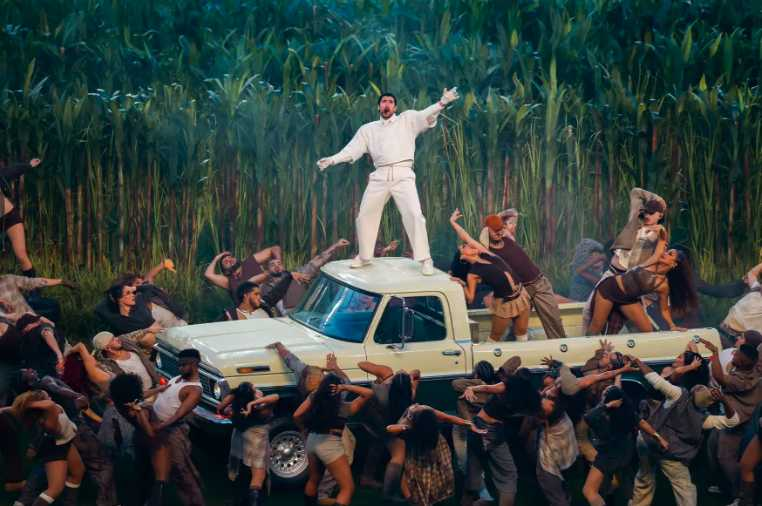
(Above: Bad Bunny commanding the stage amid dancers in a sugarcane setup, embodying Latin cultural pride during Super Bowl LX.)
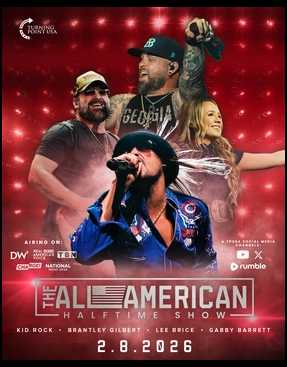
Caption(Above: Promotional image for TPUSA's All-American Halftime Show, featuring Kid Rock and country stars, highlighting patriotic themes.)
Business Contrast: Logistics, Costs, and Outcomes in a High-Stakes Arena
Financial disparities defined the show’s execution and impact, underscoring how resources dictate reach and resonance.
The NFL’s halftime, presented by Apple Music (part of a $50 million annual sponsorship deal since 2023), was a live, 13-minute extravaganza at Levi’s Stadium during the Seahawks-Patriots game. Production costs hovered between $10-20 million, covering modular stages, pyrotechnics, 400+ crew/extras, and logistics for quick setup (7 minutes). Backed by the NFL’s $18 billion empireand Roc Nation’s industry clout, it aired on NBC, Peacock, Telemundo, and NFL+, targeting a broad, diverse audience—including growing Latino and international markets—to drive streams, ad revenue ($8-10 million per 30-second spot), and global engagement.
Outcome: Record 135 million viewers (unofficial/early estimate). Official Nielsen figures released later showed a lower but still massive average: 128.2 million viewers during the halftime window (8:15–8:30 p.m. ET), with the full game averaging 124.9 million across NBC/Peacock/Telemundo/NFL+. 2 billion social impressions, and post-show streams surging; the NFL aims to expand demographics (Latinos projected for one-third sports growth by 2035) and international revenue through initiatives like Global Markets Program.
TPUSA’s pre-taped 25-27 minute show, produced in-house at an undisclosed Atlanta warehouse with a small 200-person audience, lacked a major sponsor and cost far less—likely under $1-2 million, focusing on basic staging, pyrotechnics, and artist fees (possibly pro bono or minimal). Backed by TPUSA’s nonprofit donations (no disclosed figures), it streamed on YouTube (peaking at 5-6.1 million concurrent), Rumble, DailyWire+, TBN (Christian network), OAN, and others, targeting conservative audiences frustrated with “woke” mainstream media. X streaming was canceled due to licensing issues. Outcome: 20 million+ total views post-event, respectable for a niche effort, but dwarfed by the NFL’s; TPUSA seeks to build alternative ecosystems, announcing a 2027 repeat to challenge cultural dominance.
Nuances: NFL’s scale enables high production (immersive sets) but invites “corporate wokeness” critiques; TPUSA’s low-cost model leverages digital platforms but suffers from authenticity issues (lip-syncing). Implications: Money amplifies narratives—the NFL’s budget ensures global reach, while TPUSA’s proves grassroots viability in echo chambers. Edge cases: If costs escalate, smaller outfits could innovate via social media, disrupting monopolies.
Political Contrast: Ideological Agendas and Influence in the Spotlight
Politically, the shows embodied clashing worldviews, with TPUSA’s conservative ethos challenging the NFL’s progressive leanings, all amplified by financial power.
TPUSA, founded by the late Charlie Kirk in 2012 and now led by his wife Erika Kirk, is a right-wing nonprofit focused on youth activism, promoting free markets, limited government, traditional values, and anti-“woke” culture. Backed by conservative donors (e.g., undisclosed but tied to GOP figures like President Trump, who praised the show), it believes in combating leftist dominance in media/education through events like this, framing Bad Bunny as “ridiculous” and divisive.
Why compete? To provide “patriotic” alternatives for underserved conservatives, as Kid Rock noted, amid broader fights against globalism and identity politics.
The NFL, influenced by left-leaning executives like Dasha Smith (DEI overseer), Anna Isaacson (social responsibility), and Sam Rapoport (DEI director), has advanced progressive initiatives over the last decade: Inspire Change ($250M for racial justice), End Racism messaging, LGBTQ+ Pride campaigns, kneeling support post-Kaepernick, and diverse halftime selections via Roc Nation (Jay-Z’s firm, with progressive ties like prison reform).
These women, alongside Commissioner Roger Goodell (who defied Trump’s 2025 anti-DEI order), wield significant influence, shaping policies that align with Democratic causes (e.g., 58% league PAC donations to Dems in 2024). Affiliations include partnerships with progressive nonprofits and endorsements of inclusivity, often criticized as a political agenda masked as business.
Nuances: TPUSA’s beliefs resonate with MAGA bases but risk exclusion; NFL’s initiatives empower minorities but alienate traditions. Implications: Deep pockets enable agendas—the NFL’s agenda amplifies progressivism, prompting TPUSA’s competition, which pulled impressive numbers (6M peak) for a startup. Edge cases: If TPUSA scales in 2027, it could erode NFL dominance; conversely, backlash might force NFL moderation.
Deep Pockets and the Battle for America’s Story
Super Bowl LX proved that money indeed controls the narrative: the NFL’s financial firepower delivered a polished, inclusive spectacle to 135 million, while TPUSA’s lean operation reached millions through grit and ideology. Yet, TPUSA’s success signals that alternatives can thrive in fragmented media.
As we eye 2027’s Super Bowl, will deeper pockets prevail, or will challengers rewrite the script? In a divided America, the real winner may be the ongoing debate over who defines our shared story.

H.R. 1 Also known as, the big beautiful bill has past Congress and is currently in the Senate. It’s a reconciliation bill, which means if they’re going to alter existing laws and rules and it doesn’t require a 60 vote in the Senate as votes like this can only happen three times in a fiscal year.
This bill will benefit small businesses, farmers and agricultures, People who work in FAA military military/defense/defense contractors and many more including taxpayers, earning less than $500,000 a year.
In hindsight, it looks like it’s Washington as usual. I’m talking about more spending less cutting and not keeping to their promises of cutting waste.
However, when you read over the bill, you’re gonna find that there’s $1.7 trillion in cuts more than anytime after 2005. And there’s a lot of rule changes with existing laws that go against businesses because of environmental impacts brought on by the Democrats and environmental groups.
Syrup Taste Test Showdown: Pearl Milling Co. vs Aunt Jemima
In this must-watch video, we put two iconic syrup brands head-to-head in an epic taste test battle - Pearl Milling Co. and Aunt Jemima. Which syrup reigns supreme?
We'll compare and contrast the flavors, textures, and overall taste experience of these two popular syrups. Get an insider look at the judging process as our panel of food experts meticulously analyzes and scores each syrup.
You'll get the full rundown on:
Flavor profiles (sweetness levels, notes of vanilla, maple, etc.)
Consistency and mouthfeel
Appearance and bottle design
Cost and value for money
But the real question is - who will be crowned the ultimate syrup champion? Pearl Milling Co. or Aunt Jemima? Watch to the end to find out the surprising verdict!
#syrups #pancakesyrup #foodreview #tastetestchallenge #pearlmillingco #auntjemima #breakfastfoods #maplesyrup #foodbattle
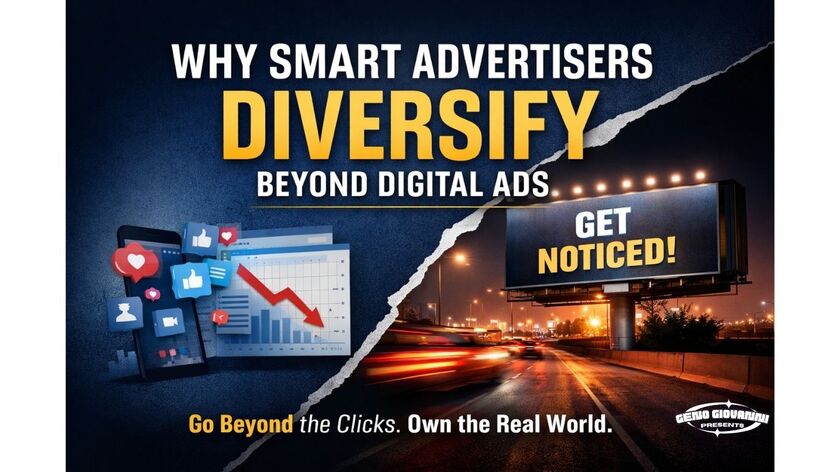
Why Smart Advertisers Diversify Beyond Digital Ads
Many businesses reach the same inflection point: digital metrics look active, but business outcomes flatten. Clicks may rise. Impressions may increase. Yet revenue growth, market visibility, and customer acquisition often fail to scale in proportion to spend.
That gap is one reason diversification has become a practical media strategy rather than a branding luxury.
Digital advertising remains useful, especially for search intent, retargeting, and direct response. But it also faces structural limitations. Average display click-through rates remain low, ad fraud continues to drain significant spend from the online ecosystem, and privacy controls have reduced the precision advertisers once relied on for tracking and targeting.
In parallel, out-of-home advertising continues to hold strategic value because it solves a different problem.
OOH is not primarily a click medium. It is a visibility medium.
It places the brand in public space, in commuting patterns, in retail corridors, and in repeated real-world exposure. Recent OOH industry materials show high audience notice levels, and current market guides continue to position digital out-of-home as a growing segment of the broader OOH market.
That does not mean every billboard impression equals perfect attention. It does mean OOH is not exposed to bot-click fraud in the same way digital media is. It also means the medium cannot be skipped with a browser extension or filtered out of a social feed. That distinction matters when brands want durable local visibility.
For advertisers, the key shift is this:
The question is no longer digital or outdoor. The better question is which part of the funnel each channel should own.
A stronger media mix often looks like this:
Google Ads for demand capture
Paid social for engagement and remarketing
OOH / DOOH for reach, frequency, and geographic dominance
Modern digital out-of-home also gives advertisers more flexibility than legacy outdoor buying. Current OOH materials highlight capabilities such as dynamic creative, scheduling by time or context, and centralized campaign management across multiple screens.
For a regional advertiser, that creates a more balanced system:
digital channels capture active interest,
outdoor builds memory and repeated exposure,
and the combination reduces dependence on any one platform’s pricing, targeting rules, or algorithm changes.
Bottom line: Diversification is not an anti-digital argument. It is a risk-management and market-presence argument.
Businesses that rely exclusively on platform-based attention are vulnerable to rising costs, measurement volatility, fraud, and policy changes. Businesses that combine digital with out-of-home are better positioned to sustain visibility, reinforce recall, and defend share of attention in the physical market.
Privacy changes impacting tracking and attribution Apple introduced App Tracking Transparency (ATT), limiting cross-app tracking and reducing advertisers’ ability to measure and target users with the same precision as before. https://developer.apple.com/app-store/user-privacy-and-data-use/
Out-of-home (OOH) reach and visibility Out of Home Advertising Association of America reports that a large majority of U.S. adults are reached by OOH advertising weekly, reinforcing its role as a high-reach, real-world media channel. https://oaaa.org/Insights/OOH-Fact-Sheet.aspx
Cross-channel effectiveness / media mix importance Nielsen research consistently shows that combining channels (including OOH with digital) improves overall campaign effectiveness and brand recall. https://www.nielsen.com/insights/
(Utah AI Bill Case Study — What Actually Happened)
In early 2026, an artificial intelligence bill moved through the Utah legislature—largely unnoticed by the general public.
That changed when a series of digital billboards appeared in Salt Lake City, addressing the debate directly and calling attention to the issue.
The bill ultimately did not pass before the legislative session ended, but the campaign revealed something more important than the outcome:
Billboards can rapidly inject an issue into public awareness—especially at the local level where policy decisions are made.
Main Point
Billboards are not just commercial tools. In policy, advocacy, and public affairs, they function as geographic amplification systems—placing messages directly into the physical environments where voters, media, and decision-makers operate.
The Utah AI bill situation did not prove that billboards “decide” outcomes. What it demonstrated is this:
When deployed strategically, billboards can accelerate awareness, frame narratives, and increase pressure in ways digital channels often cannot.
Point 1: Geographic Precision — Influence Happens Locally
Policy is decided locally. Attention must be created locally.
During the Utah AI bill debate, messaging was placed within Salt Lake City, where:
State legislators work and commute
Media coverage is concentrated
Advocacy activity is at its highest
This reflects a core principle:
Influence is not about national reach. It is about relevant reach.
Why this matters:
Legislative proximity: Messaging placed near a state capitol or major commuter corridors increases the likelihood that policymakers and politically engaged audiences encounter it.
Constituent alignment: Local residents—not national audiences—contact representatives, attend hearings, and shape political pressure.
Efficient spend: Targeted outdoor placements concentrate impressions where they can affect outcomes, rather than dispersing them across irrelevant geographies.
Strategic takeaway: If the objective is to influence a state or municipal issue, media placement must align with the geographic footprint of decision-making, not the size of the total audience.
Point 2: Persistent Visibility — Physical Media Creates Repetition
Digital messaging competes for attention. Physical media occupies space.
Billboards operate on a different exposure model:
They are continuously visible
They do not require user interaction
They deliver repeated impressions over time
In a commuting environment, this creates:
Frequency accumulation (the same audience sees the message multiple times)
Message familiarity (recognition increases with repetition)
Baseline awareness (even passive exposure introduces the topic)
It is inaccurate to say billboards are “unavoidable,” but it is accurate to say:
They are consistently present in a way digital ads are not.
In the Utah case:
The billboards did not explain the full legislation
They did not require clicks or engagement
They simply ensured the issue became visible in the public environment
Strategic takeaway: When awareness is low, the first objective is not persuasion—it is exposure. Billboards are highly effective at establishing that baseline.
Caption
Point 3: Message Compression — Complexity Becomes a Position
Legislation is complex. Public opinion is not.
Billboards impose strict constraints:
Limited words
Short viewing time
High emphasis on clarity
This forces campaigns to:
Define a single position
Use simple, memorable language
Focus on framing, not explanation
In practice, this means:
The audience may not understand the full policy
But they understand what the issue is about
And often, which side they align with
This is not unique to billboards, but billboards enforce it more aggressively than most media.
Strategic takeaway: If a message cannot be reduced to a clear, repeatable idea, it will not scale in public discourse—regardless of channel.
What the Utah Case Actually Demonstrates
The Utah AI bill campaign does not prove causation between billboards and legislative outcomes.
It does demonstrate three measurable effects:
Issue visibility can be created quickly in a defined geography
Physical media can reinforce a narrative through repetition
Simple framing can enter public conversation without requiring deep engagement
These are not theoretical advantages. They are operational realities of outdoor media.
Conclusion: Billboards as Awareness Infrastructure
Billboards are best understood not as persuasion tools in isolation, but as infrastructure for attention.
They do not:
Replace digital targeting
Deliver granular attribution
Provide detailed messaging
They do:
Establish presence
Reinforce messaging through repetition
Anchor issues in physical space
In policy, advocacy, and regional campaigns, this makes them uniquely useful.
Digital channels distribute messages. Billboards convey messages.
And in many cases, where a message appears matters as much as what it says.
Final Position
The Utah AI bill case is not evidence that billboards “win” political fights.
It is evidence of something more foundational:
If people are not aware of an issue, nothing else matters.
Billboards remain one of the most direct ways to ensure that awareness exists— in the exact places where decisions, conversations, and influence actually occur.
I've managed outdoor advertising campaigns for eight years. The ones that fail share three predictable mistakes—and none of them are "bad creative" or "low budget."
Most businesses kill their billboard ROI before the campaign even starts. Here's what actually goes wrong.
Mistake #1: Picking Locations Based on Price, Not Customer Behavior
A business owner calls me: "I found a billboard on Highway 99 for $2,500/month. It's half the price of the Highway 50 board. Should I grab it?"
I ask: "Where do your customers drive?"
Silence.
"Well... Highway 99 is busier, right? More impressions per dollar?"
Here's the problem: Their customers are affluent suburban families in El Dorado Hills and Folsom. They commute on Highway 50 every single day. They never touch Highway 99.
The "cheap" board delivers 50,000 impressions per day to the WRONG audience. Zero revenue.
The "expensive" Highway 50 board? 15,000 impressions per day to THEIR EXACT CUSTOMERS. That's where sales happen.
The lesson: Traffic volume is a vanity metric. Customer geography is a revenue metric.
Before you pick a billboard, answer this: Where do my buyers drive every day? Not "where's the most traffic" but "where are MY people commuting?"
That's your corridor. That's your ROI.
Mistake #2: Treating Billboards Like Facebook Ads
A client launches a four-week campaign on Business 80. Day 3, they check their website analytics.
"We got 12 visitors. This isn't working. Can we cancel?"
Here's what they don't understand: Outdoor advertising isn't direct response. It's brand awareness.
Facebook ads work on a 24-hour cycle. You run an ad, someone clicks, you get a lead. Immediate feedback loop.
Billboards work on a 90-day cycle. Week 1-2: Your audience barely notices. Week 3-4: They start recognizing your brand. Month 2: They remember you exist. Month 3: When they NEED your service, you're the first name they think of.
If you need leads THIS WEEK, run Facebook ads. They're built for speed.
If you want market dominance—where your name is the FIRST thing buyers think of when they're ready—run outdoor. But give it time.
I've watched clients quit at Day 14. Right before momentum kicks in. Right before their phone starts ringing.
The lesson: Outdoor is compound interest for your brand. It builds slowly, then all at once. Don't bail before you hit critical mass.
Mistake #3: Trying to Say Everything (And Saying Nothing)
I see this constantly: A billboard with the company name, tagline, three services listed, phone number, website URL, QR code, and social media handles.
The designer thinks: "We paid $4,000. Let's use every inch!"
Here's reality: A driver has 3-5 seconds to read your board while moving at 65 mph. Anything beyond 7 words is invisible.
That cluttered board? It blends into every other billboard. Forgettable. Generic. Ignored.
The boards that WORK? One message. One action. Maximum contrast.
Examples:
Bad: "Premier Home Improvement | Windows, Doors, Siding | Call 916-555-1234 | www.website.com | Licensed & Insured Since 1987"
Good: "New Windows. Half Price. 916-555-1234"
Bad: "Family Law Attorney | Divorce • Custody • Support | Free Consultation | Hablamos Español"
Good: "Divorce? Call Jane. 916-555-HELP"
Less is more. Clarity beats cleverness. Contrast over complexity.
The lesson: Your billboard has one job—get them to take ONE action. Make it impossible to miss.
The Pattern Behind the Failures
These three mistakes have a common thread: Businesses treat billboards like every other advertising channel.
They optimize for cost (Mistake #1), expect instant results (Mistake #2), and overload the message (Mistake #3).
But outdoor advertising doesn't work like digital. It's a different medium with different rules.
When you understand the rules—pick boards where YOUR customers drive, give campaigns time to compound, and ruthlessly simplify your message—outdoor becomes one of the most cost-effective brand channels you can run.
I've seen it work for tree farms, homebuilders, auto dealerships, and law firms. Not because they had huge budgets. Because they avoided these three mistakes.
What's Next
If you're exploring outdoor advertising for your business and want to avoid wasting $40K on the wrong corridor, wrong timeline, or wrong creative, let's talk strategy first.
I offer two paths:
Full Service ($4,000): I handle everything—strategy, creative direction, campaign setup, and 4-week management. You focus on your business while I make sure your outdoor spend actually works.
Local Brand Starter Kit ($1,000): Brand foundation package before you scale—story framework, 30-day content map, launch newsletter, platform setup. Perfect if you need messaging dialed in first.
Or keep following along. Next week, I'm breaking down Sacramento's three billboard corridors (Highway 50, I-80, Business 80) and which one your business should own.
Different audiences. Different buying power. Different goals.
Most advertisers treat them as interchangeable. That's another $40K mistake.
Sign Up for free to see more from this community or subscribe to Geno Giovanni Presents for $5/month to support Geno Giovanni Presents for more interaction and exclusive content.