Geno Giovanni Presents
Politics • Culture • Business
Why Geography Became Marketing's Most Valuable Asset
February 24, 2026
post photo preview
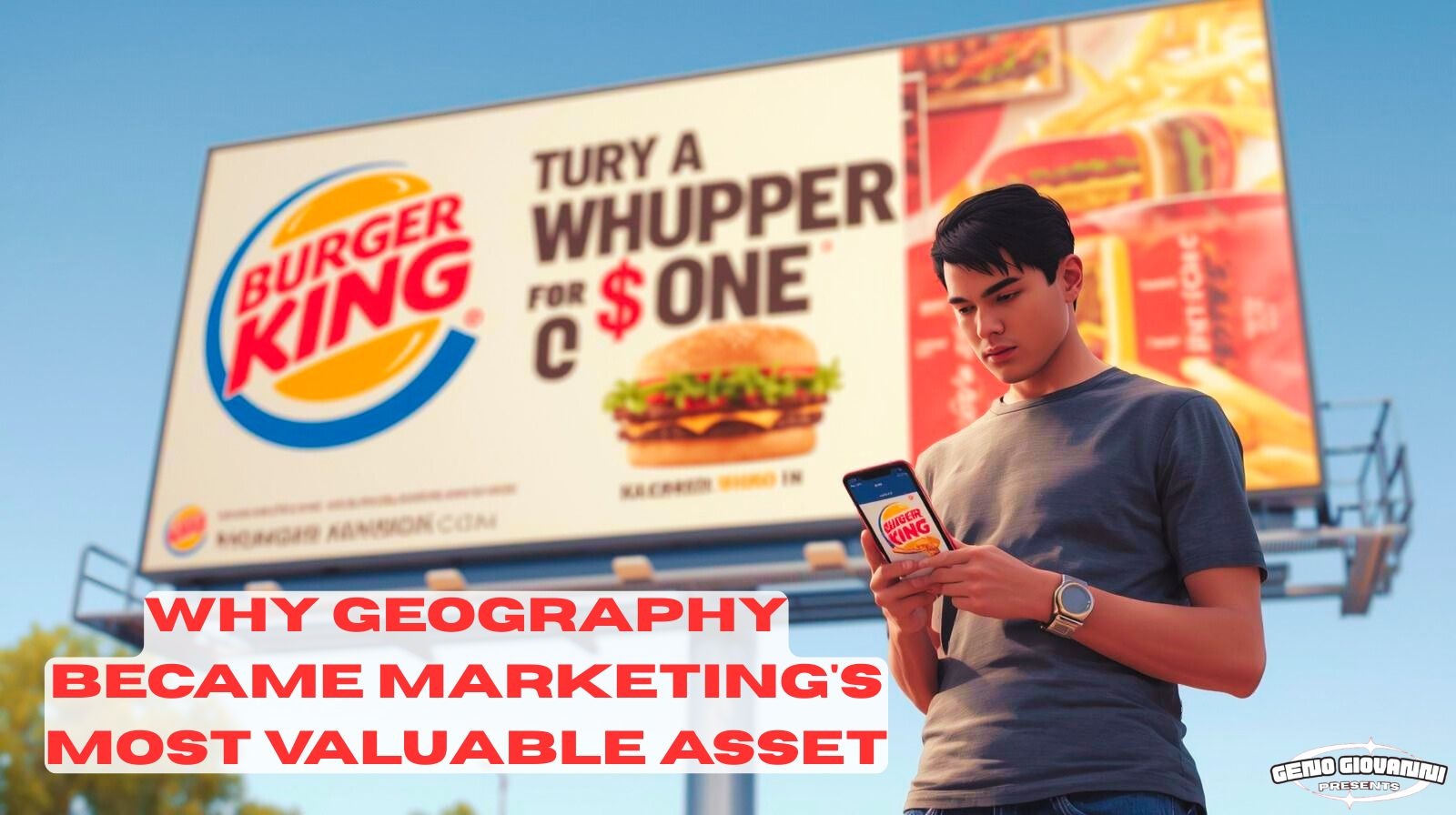
Burger Kind advertised to get a Whopper for one cent. This happend when their customers were in a certain area.

The most sophisticated marketers aren't chasing impressions anymore. They're chasing geographic relevance.

Here's what's shifting:

According to Market Vantage's 2025 analysis, competitive verticals are seeing digital CPC inflation running 4-12% annually—well ahead of general inflation—with WordStream reporting roughly 40% increases over three years in high-demand categories. At the same time, Seer Interactive's study of 25.1 million impressions found that Google AI Overviews caused organic CTRs to drop 61% and paid CTRs to fall 68% across informational queries.

Translation: Digital advertising is compressing efficiency. Costs rise faster than performance improves, forcing marketers to evaluate which channels offer sustainable ROI.

So where is the smart money moving?

Geographic precision. Not as a replacement for digital, but as a strategic complement.

Real-world examples:

Burger King geofenced every McDonald's location nationwide. Open their app within 600 feet of a McDonald's, get a Whopper for one cent. Starbucks sends personalized Happy Hour deals when you're near a store. Uber creates "tripwire" fences around airports so passengers get driver notifications the moment they deplane.

The pattern: Reaching the right people in the right location beats reaching millions of random users.

And here's the advantage outdoor advertising has always had:

Digital platforms spend billions engineering geo-targeting capabilities that approximate physical presence. Billboards don't need to approximate anything. They ARE physical presence.

A billboard on Highway 50 doesn't follow people around the internet hoping to catch them at the right moment. It sits in ONE location where your ideal customers drive every single day. That's not a limitation—that's precision by design.

The question isn't whether geographic marketing works. The question is: Are you reaching your customers where they actually are?

Want to map your market properly? Schedule a strategy session


Sources:

  • WordStream. "Google Ads Benchmarks 2025." September 2025.
  • Market Vantage. "Digital Advertising Cost Effectiveness: Recent Trends." July 2025.
  • Seer Interactive. "AIO Impact on Google CTR: September 2025 Update." November 2025.
  • Marketing Evolution. "Geofencing Marketing Examples." 2025.

community logo
Join the Geno Giovanni Presents Community
To read more articles like this, sign up and join my community today
0
What else you may like…
Videos
Posts
Articles
Big Beautiful Bill Quick Take

H.R. 1 Also known as, the big beautiful bill has past Congress and is currently in the Senate. It’s a reconciliation bill, which means if they’re going to alter existing laws and rules and it doesn’t require a 60 vote in the Senate as votes like this can only happen three times in a fiscal year.

This bill will benefit small businesses, farmers and agricultures, People who work in FAA military military/defense/defense contractors and many more including taxpayers, earning less than $500,000 a year.

In hindsight, it looks like it’s Washington as usual. I’m talking about more spending less cutting and not keeping to their promises of cutting waste.

However, when you read over the bill, you’re gonna find that there’s $1.7 trillion in cuts more than anytime after 2005. And there’s a lot of rule changes with existing laws that go against businesses because of environmental impacts brought on by the Democrats and environmental groups.

There’s also claims that will be tax breaks ...

00:02:25
Cereal For Dinner

Big food wants you to have cereal for dinner as a alternative to what you would normally have. So I tired it and was not a fan.

00:00:09
Syrup Taste Test Showdown: Pearl Milling Co. vs Aunt Jemima

In this must-watch video, we put two iconic syrup brands head-to-head in an epic taste test battle - Pearl Milling Co. and Aunt Jemima. Which syrup reigns supreme?
We'll compare and contrast the flavors, textures, and overall taste experience of these two popular syrups. Get an insider look at the judging process as our panel of food experts meticulously analyzes and scores each syrup.
You'll get the full rundown on:
Flavor profiles (sweetness levels, notes of vanilla, maple, etc.)
Consistency and mouthfeel
Appearance and bottle design
Cost and value for money
But the real question is - who will be crowned the ultimate syrup champion? Pearl Milling Co. or Aunt Jemima? Watch to the end to find out the surprising verdict!
#syrups #pancakesyrup #foodreview #tastetestchallenge #pearlmillingco #auntjemima #breakfastfoods #maplesyrup #foodbattle

00:00:43
post photo preview
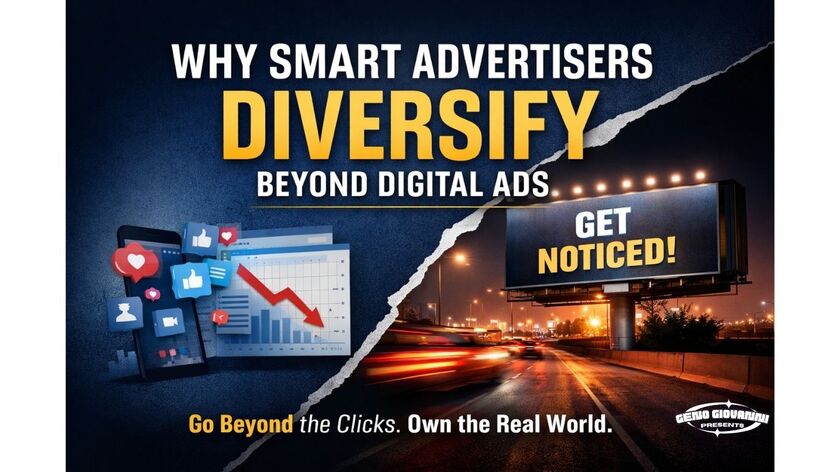
Why Smart Advertisers Diversify Beyond Digital Ads

Many businesses reach the same inflection point: digital metrics look active, but business outcomes flatten. Clicks may rise. Impressions may increase. Yet revenue growth, market visibility, and customer acquisition often fail to scale in proportion to spend.

That gap is one reason diversification has become a practical media strategy rather than a branding luxury.

Digital advertising remains useful, especially for search intent, retargeting, and direct response. But it also faces structural limitations. Average display click-through rates remain low, ad fraud continues to drain significant spend from the online ecosystem, and privacy controls have reduced the precision advertisers once relied on for tracking and targeting.

In parallel, out-of-home advertising continues to hold strategic value because it solves a different problem.

OOH is not primarily a click medium. It is a visibility medium.

It places the brand in public space, in commuting patterns, in retail corridors, and in repeated real-world exposure. Recent OOH industry materials show high audience notice levels, and current market guides continue to position digital out-of-home as a growing segment of the broader OOH market.

That does not mean every billboard impression equals perfect attention. It does mean OOH is not exposed to bot-click fraud in the same way digital media is. It also means the medium cannot be skipped with a browser extension or filtered out of a social feed. That distinction matters when brands want durable local visibility.

For advertisers, the key shift is this:

The question is no longer digital or outdoor.
The better question is which part of the funnel each channel should own.

A stronger media mix often looks like this:

  • Google Ads for demand capture

  • Paid social for engagement and remarketing

  • OOH / DOOH for reach, frequency, and geographic dominance

Modern digital out-of-home also gives advertisers more flexibility than legacy outdoor buying. Current OOH materials highlight capabilities such as dynamic creative, scheduling by time or context, and centralized campaign management across multiple screens.

For a regional advertiser, that creates a more balanced system:

  • digital channels capture active interest,

  • outdoor builds memory and repeated exposure,

  • and the combination reduces dependence on any one platform’s pricing, targeting rules, or algorithm changes.

Bottom line:
Diversification is not an anti-digital argument. It is a risk-management and market-presence argument.

Businesses that rely exclusively on platform-based attention are vulnerable to rising costs, measurement volatility, fraud, and policy changes. Businesses that combine digital with out-of-home are better positioned to sustain visibility, reinforce recall, and defend share of attention in the physical market.


Sources

Click-through rates (low engagement in display advertising)
WordStream reports average Google Display Network click-through rates around ~0.46%, indicating the majority of impressions do not generate user action.
https://www.wordstream.com/blog/ws/2016/02/29/google-adwords-industry-benchmarks

Ad fraud and invalid traffic in digital advertising
Juniper Research estimates advertisers lose approximately $84 billion annually to ad fraud, highlighting systemic inefficiencies in digital media buying.
https://www.juniperresearch.com/press/press-releases/ad-fraud-costs-to-advertisers-to-reach-84bn

Privacy changes impacting tracking and attribution
Apple introduced App Tracking Transparency (ATT), limiting cross-app tracking and reducing advertisers’ ability to measure and target users with the same precision as before.
https://developer.apple.com/app-store/user-privacy-and-data-use/

Out-of-home (OOH) reach and visibility
Out of Home Advertising Association of America reports that a large majority of U.S. adults are reached by OOH advertising weekly, reinforcing its role as a high-reach, real-world media channel.
https://oaaa.org/Insights/OOH-Fact-Sheet.aspx

Growth of digital out-of-home (DOOH)
Out of Home Advertising Association of America notes that roughly one-third of OOH revenue is now digital, with continued growth driven by programmatic and dynamic capabilities.
https://oaaa.org/news/new-study-finds-digital-out-of-home-advertising-surpasses-other-media-in-driving-favorability-and-action-among-consumers/

Cross-channel effectiveness / media mix importance
Nielsen research consistently shows that combining channels (including OOH with digital) improves overall campaign effectiveness and brand recall.
https://www.nielsen.com/insights/


Read full Article
post photo preview
HOW BILLBOARDS SHAPE PUBLIC OPINION
(Utah AI Bill Case Study — What Actually Happened)

In early 2026, an artificial intelligence bill moved through the Utah legislature—largely unnoticed by the general public.

That changed when a series of digital billboards appeared in Salt Lake City, addressing the debate directly and calling attention to the issue.

The bill ultimately did not pass before the legislative session ended, but the campaign revealed something more important than the outcome:

Billboards can rapidly inject an issue into public awareness—especially at the local level where policy decisions are made.


Main Point

Billboards are not just commercial tools. In policy, advocacy, and public affairs, they function as geographic amplification systems—placing messages directly into the physical environments where voters, media, and decision-makers operate.

The Utah AI bill situation did not prove that billboards “decide” outcomes.
What it demonstrated is this:

When deployed strategically, billboards can accelerate awareness, frame narratives, and increase pressure in ways digital channels often cannot.


Point 1: Geographic Precision — Influence Happens Locally

Policy is decided locally. Attention must be created locally.

During the Utah AI bill debate, messaging was placed within Salt Lake City, where:

  • State legislators work and commute

  • Media coverage is concentrated

  • Advocacy activity is at its highest

This reflects a core principle:

Influence is not about national reach. It is about relevant reach.

Why this matters:

  • Legislative proximity: Messaging placed near a state capitol or major commuter corridors increases the likelihood that policymakers and politically engaged audiences encounter it.

  • Constituent alignment: Local residents—not national audiences—contact representatives, attend hearings, and shape political pressure.

  • Efficient spend: Targeted outdoor placements concentrate impressions where they can affect outcomes, rather than dispersing them across irrelevant geographies.

Strategic takeaway:
If the objective is to influence a state or municipal issue, media placement must align with the geographic footprint of decision-making, not the size of the total audience.


Point 2: Persistent Visibility — Physical Media Creates Repetition

Digital messaging competes for attention. Physical media occupies space.

Billboards operate on a different exposure model:

  • They are continuously visible

  • They do not require user interaction

  • They deliver repeated impressions over time

In a commuting environment, this creates:

  • Frequency accumulation (the same audience sees the message multiple times)

  • Message familiarity (recognition increases with repetition)

  • Baseline awareness (even passive exposure introduces the topic)

It is inaccurate to say billboards are “unavoidable,” but it is accurate to say:

They are consistently present in a way digital ads are not.

In the Utah case:

  • The billboards did not explain the full legislation

  • They did not require clicks or engagement

  • They simply ensured the issue became visible in the public environment

Strategic takeaway:
When awareness is low, the first objective is not persuasion—it is exposure.
Billboards are highly effective at establishing that baseline.


Public Opinion Doesn’t Start Online. It Starts Here.
Caption


Point 3: Message Compression — Complexity Becomes a Position

Legislation is complex. Public opinion is not.

Billboards impose strict constraints:

  • Limited words

  • Short viewing time

  • High emphasis on clarity

This forces campaigns to:

  • Define a single position

  • Use simple, memorable language

  • Focus on framing, not explanation

In practice, this means:

  • The audience may not understand the full policy

  • But they understand what the issue is about

  • And often, which side they align with

This is not unique to billboards, but billboards enforce it more aggressively than most media.

Strategic takeaway:
If a message cannot be reduced to a clear, repeatable idea, it will not scale in public discourse—regardless of channel.


What the Utah Case Actually Demonstrates

The Utah AI bill campaign does not prove causation between billboards and legislative outcomes.

It does demonstrate three measurable effects:

  1. Issue visibility can be created quickly in a defined geography

  2. Physical media can reinforce a narrative through repetition

  3. Simple framing can enter public conversation without requiring deep engagement

These are not theoretical advantages. They are operational realities of outdoor media.


Conclusion: Billboards as Awareness Infrastructure

Billboards are best understood not as persuasion tools in isolation, but as infrastructure for attention.

They do not:

  • Replace digital targeting

  • Deliver granular attribution

  • Provide detailed messaging

They do:

  • Establish presence

  • Reinforce messaging through repetition

  • Anchor issues in physical space

In policy, advocacy, and regional campaigns, this makes them uniquely useful.

Digital channels distribute messages.
Billboards convey messages.

And in many cases, where a message appears matters as much as what it says.


Final Position

The Utah AI bill case is not evidence that billboards “win” political fights.

It is evidence of something more foundational:

If people are not aware of an issue, nothing else matters.

Billboards remain one of the most direct ways to ensure that awareness exists—
in the exact places where decisions, conversations, and influence actually occur.


Sources

  1. Axios — White House pressures Utah on AI transparency bill (Feb 2026)
    https://www.axios.com/2026/02/15/white-house-utah-ai-transparency-bill

  2. Axios — Utah billboards target AI policy debate (Feb 26, 2026)
    https://www.axios.com/2026/02/26/utah-billboards-david-sacks-ai-bill

  3. Axios — White House scrutiny of state AI laws (Mar 6, 2026)
    https://www.axios.com/2026/03/06/white-house-red-state-ai-laws-scrutiny

  4. Mintz — Utah AI bill policy analysis (Feb 27, 2026)
    https://www.mintz.com/insights-center/viewpoints/54731/2026-02-27-white-house-ai-policy-update-utah-ai-bill-opposition

Read full Article
post photo preview
Why Most Billboard Campaigns Fail
And It's Not What You Think

I've managed outdoor advertising campaigns for eight years. The ones that fail share three predictable mistakes—and none of them are "bad creative" or "low budget."

Most businesses kill their billboard ROI before the campaign even starts. Here's what actually goes wrong.


Mistake #1: Picking Locations Based on Price, Not Customer Behavior

A business owner calls me: "I found a billboard on Highway 99 for $2,500/month. It's half the price of the Highway 50 board. Should I grab it?"

I ask: "Where do your customers drive?"

Silence.

"Well... Highway 99 is busier, right? More impressions per dollar?"

Here's the problem: Their customers are affluent suburban families in El Dorado Hills and Folsom. They commute on Highway 50 every single day. They never touch Highway 99.

The "cheap" board delivers 50,000 impressions per day to the WRONG audience. Zero revenue.

The "expensive" Highway 50 board? 15,000 impressions per day to THEIR EXACT CUSTOMERS. That's where sales happen.

The lesson: Traffic volume is a vanity metric. Customer geography is a revenue metric.

Before you pick a billboard, answer this: Where do my buyers drive every day? Not "where's the most traffic" but "where are MY people commuting?"

That's your corridor. That's your ROI.


Mistake #2: Treating Billboards Like Facebook Ads

A client launches a four-week campaign on Business 80. Day 3, they check their website analytics.

"We got 12 visitors. This isn't working. Can we cancel?"

Here's what they don't understand: Outdoor advertising isn't direct response. It's brand awareness.

Facebook ads work on a 24-hour cycle. You run an ad, someone clicks, you get a lead. Immediate feedback loop.

Billboards work on a 90-day cycle. Week 1-2: Your audience barely notices. Week 3-4: They start recognizing your brand. Month 2: They remember you exist. Month 3: When they NEED your service, you're the first name they think of.

If you need leads THIS WEEK, run Facebook ads. They're built for speed.

If you want market dominance—where your name is the FIRST thing buyers think of when they're ready—run outdoor. But give it time.

I've watched clients quit at Day 14. Right before momentum kicks in. Right before their phone starts ringing.

The lesson: Outdoor is compound interest for your brand. It builds slowly, then all at once. Don't bail before you hit critical mass.


Mistake #3: Trying to Say Everything (And Saying Nothing)

I see this constantly: A billboard with the company name, tagline, three services listed, phone number, website URL, QR code, and social media handles.

The designer thinks: "We paid $4,000. Let's use every inch!"

Here's reality: A driver has 3-5 seconds to read your board while moving at 65 mph. Anything beyond 7 words is invisible.

That cluttered board? It blends into every other billboard. Forgettable. Generic. Ignored.

The boards that WORK? One message. One action. Maximum contrast.

Examples:

Bad: "Premier Home Improvement | Windows, Doors, Siding | Call 916-555-1234 | www.website.com | Licensed & Insured Since 1987"

Good: "New Windows. Half Price. 916-555-1234"

Bad: "Family Law Attorney | Divorce • Custody • Support | Free Consultation | Hablamos Español"

Good: "Divorce? Call Jane. 916-555-HELP"

Less is more. Clarity beats cleverness. Contrast over complexity.

The lesson: Your billboard has one job—get them to take ONE action. Make it impossible to miss.


The Pattern Behind the Failures

These three mistakes have a common thread: Businesses treat billboards like every other advertising channel.

They optimize for cost (Mistake #1), expect instant results (Mistake #2), and overload the message (Mistake #3).

But outdoor advertising doesn't work like digital. It's a different medium with different rules.

When you understand the rules—pick boards where YOUR customers drive, give campaigns time to compound, and ruthlessly simplify your message—outdoor becomes one of the most cost-effective brand channels you can run.

I've seen it work for tree farms, homebuilders, auto dealerships, and law firms. Not because they had huge budgets. Because they avoided these three mistakes.


What's Next

If you're exploring outdoor advertising for your business and want to avoid wasting $40K on the wrong corridor, wrong timeline, or wrong creative, let's talk strategy first.

I offer two paths:

Full Service ($4,000): I handle everything—strategy, creative direction, campaign setup, and 4-week management. You focus on your business while I make sure your outdoor spend actually works.

Local Brand Starter Kit ($1,000): Brand foundation package before you scale—story framework, 30-day content map, launch newsletter, platform setup. Perfect if you need messaging dialed in first.

Book a consultation here →https://calendly.com/genogiovanni

Or keep following along. Next week, I'm breaking down Sacramento's three billboard corridors (Highway 50, I-80, Business 80) and which one your business should own.

Different audiences. Different buying power. Different goals.

Most advertisers treat them as interchangeable. That's another $40K mistake.

Talk soon,
Geno

Read full Article
See More
Available on mobile and TV devices
google store google store app store app store
google store google store app tv store app tv store amazon store amazon store roku store roku store
Powered by Locals